Sunday, February 14, 2010

Homo Sapian Pride: The Fun Side of Humanity

You can't help but feel proud to be human whenever you check out flash mob accomplishments. We are social animals and we enjoy very much group activities. Oddly enough, watching all 25 of the flash mob videos reminded me of Frans de Waal, a primatologist at the Yerkes National Primate Research Center, and how he compares humanity as a cross between the peace, fun loving Bonobo and the warlike, patriarchal chimpanzee:

"In particular, he says, we can learn as much about human evolution and behavior by studying the sensitive, peace-loving bonobo as by studying the more violent chimpanzee—both of which share more than 98 percent of our DNA. In this interview, de Waal explains what the ape he calls the "make-love-not-war" primate can teach us about who we are..."


Flash mobs are a manifestation of our bonobo side, the fun, amazing part of living and being a human that exists and thrives despite, the war, inequality and violence of our chimpanzee roots.

Just some food for thought.

Tuesday, February 9, 2010

Have Corporations Gone Overboard with Advertising?

The rise of "conversational media", defined as a two way model of advertising between consumer and producer, is a direct result of years of pent up frustration with traditional advertising having over-saturated every sector of a consumer's life. This pent up frustration recently in the Brazilian city of São Paulo took the form of a complete ban on public advertising:


Courtesy of Walker Art Center

São Paulo's conservative Mayor, Gilberto Kassab, stated that his opposition to outdoor advertising was rooted in his desire to reduce pollution in his city:

"The Clean City Law came from a necessity to combat pollution . . . pollution of water, sound, air, and the visual. We decided that we should start combating pollution with the most conspicuous sector – visual pollution... surveys indicate that the measure is extremely popular with the city's residents, with more than 70 percent approval."


Conversational media is the great hope for advertising agencies increasingly facing market challenges like the decline of the traditional magazine/newspaper industry and the rise of the commercial-skipper DVRs. This media platform is simply a band-aid for the industry, which seems stuck in a cycle of over-saturating consumers in all possible mediums and seeing what sticks.

Consumers are not terribly content with the current state of advertising affairs:

71% say there are too many ads on TV.

44% say they skip ads more often than they did a year ago by turning down the TV, changing the channel, or fast-forwarding through commercials.

Over one-half of Americans (56%) say there are too may ads on the Internet


Courtesy of Marketing Profs


Just some food for thought.

Monday, February 1, 2010

Polemical Overdose: Lay off the Craziness Keen


This Picture Sums up Keen's mentality in his manifesto "The Digital Emperor Has No Clothes".

Keen is indeed a romantic writer, one who cannot thrive literarily unless he feeds on stark contrast and manufactured controversy. Well, ok I'll concede, he grasps certain struggles and rivalries that have sometimes bubbled up over the years between the "blogger" and the "the professional reporter." I must also point out however that he uses a powerful magnifying glass to blow the issue into historic proportions. In his rush to prove a point he fails to acknowledge successful efforts of making reporting a partnership between reader and reporter.

These entities have created very successful partnerships, most recently with the June 2009 Iran election protests, where young progressive Iranian reformers protested what many see as a stolen election by the theocratic regime. These protests were indeed the largest Iran has seen since the Iranian Revolution.

In this event Iranian social media provided primary footage and documentation for the traditional world media establishment to aggregate. Social media forced traditional media to respond earlier than usual to this story, in effect ensuring that traditional media would provide their consumer base with the most up to date information and developments.

For the first few days of the protests, it felt very surreal for me as a media consumer to see the Iran elections dominate social media coverage, yet hardly any mention in traditional media sources like CNN or the New York Times that I pay attention to. I remember the campaign to change people's Twitter Avatar pictures green to show solidarity. I still have that greeen avatar to date.

National media sources, and even local American media as you will see below, were able to access this video and primary reporting for free from social networking. Previously these media companies would have to pay up large sums of money for reporters, cameramen, and security for their staff on the ground.

These are still important functions of a news media organization, however more often than not conflicts tend to breed restrictions to on the ground media reporting. When this happens and traditional news media cannot use their usual reporters, turning to social networking allows them to continue reporting on the issue with up to date information.


Keen is way too polemical for my tastes. The relationship between traditional and social media is more complex than "Is it good or bad? Part of the solution or part of the problem?" Keen mainly wants is for someone to tell him how important he still is. Indeed, someone should do so immediately, before we are subjected to another self-aggrandizing piece by him.

Monday, January 25, 2010

Crowdsourcing is NOT Your Knight in Shining Armor


Techies love to hail every advance of technological tools as the next best thing since sliced bread. This was the clear impression I received from author Jeff Howe's video on Crowdsourcing. When not making pop-technological youtube videos, Jeff Howe is a writer, most recently publishing "Crowdsourcing: Why the Power of the Crowd is Driving the Future of Business". Crowdsourcing by the way is defined by Mr. Howe as:

The application of the open-source idea to any field outside of software, taking a function performed by people in an organization, such as reporting done by journalists, research and product development by scientists, or design of a T-shirt, for example, and, in effect, "outsourcing" it through an open-air broadcast on the Internet.


Mr. Howe makes some very important points about how the internet has revolutionized how people connect to other people in their profession, hobby or identity. The points he makes however, for someone like myself that grew up with the internet as a given, seem like a statement of the obvious. Yes we have seen new content produced by a mass of people (i.e. Wikipedia) so many times in our generation, yet crowdsourcing is often made out to seem as some egalitarian technological utopia just arriving to save the human species, when in fact it is not.

Mary Joyce, co-founder of the blog DigiActive, which helps grassroots activists around the world use the Internet and mobile phones to increase their impact, issued a scathing indictment of crowdsourcing as a cureall:

"The key is that crowdsourcing is still centralized: the producer is still a cog in a machine, only the machine is bigger... the task is defined at the center, produced at the edge. It is no coincidence that the term crowdsourcing derives from another practice of hierarchical labor distribution: outsourcing."


Initially Mary's analysis sounded too theoretical and abstract for my tastes. However I sat with Mary's analysis and recognized how it applies to, say, the political realm. A key example of crowdsourcing is clearly my.barackobama.com, Candidate Barack Obama's innovative use of a social networking and crowdsourcing to allow people a space to contribute in many ways to his campaign in a decentralized manner. Nevertheless, it was still controlled by his campaign.

The website was owned and patrolled by the Obama Campaign, to ensure that potentially embarrassing user produced content within the site was regulated. Now obviously my.barackobama was an astounding success, however that does not take away the fact that the users did not have as much control on the campaign as the campaign wanted you to think. For example, users on my.barackobama.com banded together to create what was at one point the fastest growing and largest group on that site: "Get FISA Right". The group sought to make Obama oppose Telecom Immunity for industries that illegally participated in state-sponsored domestic spying campaigns under the Bush administration.

Take a look at how active the members of "Get FISA Right" were in the overall Obama for President campaign.

# of Members 23,178
Events Hosted 5,103
Events Attended 40,610
Calls made 225,373
Doors Knocked 5,296
Number of blog posts 123,109
Amount raised $730,212.32

Despite all this pushback on this one issue by the most active members on his site, who so clearly contributed nearly a million dollars and a quarter million calls for his campaign, the only concession Obama made was a half-hearted statement saying that he and the group members of "Get FISA Right" can "Agree to Disagree". The power dynamics at play are very clear.

In contrast, think about the recent Tea Party Protests. Now those protests kinda came out of nowhere. Who would have thought we'd all be looking at a bunch of angry people carrying tea bags while marching on our nation's capitol? Sure, recently the Tea Party movement has shown signs of centralization, however at its early pinnacle it was one of the most powerful political movements created by what Mary at DigiActive would call this Peer to Peer Production:

Peer to peer production is different: it is center-less and it is non-hierarchical. Even if someone is organizing, that person has no more power than any other member of the project. There is no center and edge. There is only the network... It is all about who benefits and where the power lies...

For example, the current state of the Tea Party movement in the United States, though espousing conservative political views, is not centrally organized by traditional powers of the right, including the Republican party.

When power is concentrated in groups of citizens rather than institutions, there is a potential for lack of accountability as the group may rely on no one but its members for resources. However, the lack of connection to traditional power structures could also mean the group is not beholden to institutions that are accountable to special interests such as corporations or economic, religious, or political elites.


Perhaps crowdsourcing, already long praised as an innovative new technology, is already being overshadowed by user peer to peer production. Just as institutions are beginning to utilize crowdsourcing, new parts are beginning to self-assemble into new institutions through the power of peer to peer production, to rival their predecessors.

Perhaps I set up a false dichotomy in alluding to a competition between crowdsourcing and peer to peer production. Both tools have very real applications, albeit in different settings. One can however, see how easily these two tools can become a proxy war in the fight for domination and influence in our societies, battles played out since the very beginning of humankind.

In this battle, Crowdsourcing may be the dragon, representing old, established institutions, while peer to peer production plays the role as the knight, rising from the fearful masses to challenge and topple the existing social/political/class structure.
Sunday, January 17, 2010

Playing Golf With The Boss: 3 Ways to Utilize Informal Social Networks for Political Inclusion


Affirmative Action. Quotas. Pick yourself up by your bootsraps. Good Old Hard Work. Increased education funding.


These are all various proposed methods over the decades for dealing with our nation’s history of racial, gender, and class disparity in politics. These proposals, all with important elements, completely ignore a key enforcer of inequality: the disparity among social groups in access to informal networks. We know what forms these disparities take place. The mens’ locker room job offers, suburban community center social nights, having that family friend who secures for you the internship you’ve always wanted. These opportunities are rarely seen as advantages by those who already have access to them. In fact, Barack Obama, one of the greatest beneficiaries of informal networks of all time, failed to see this point recently:

"Does the White House feel like a frat house? The suspicion flared in recent weeks — and not for the first time — after President Obama was criticized by women’s advocates and liberal bloggers for hosting a high-level basketball game with no female players... The technical foul over the all-male game has become a nagging concern for a White House that has battled an impression dating to the presidential campaign that Mr. Obama’s closest advisers form a boys’ club and that he is too frequently in the company of only men — not just when playing sports, but also when making big decisions.”


Barack Obama has presided over many precedent setting appointees for women and racial minorities, from African-American Attorney General Eric Holder, the first black Attorney General in American History, to Justice Sonia Sotomayor, the first latina Supreme Court Justice. Considering diversity in high level appointees is an admirable decision to be encouraged. Indeed, such appointees almost always have more than qualified professional credentials to stand on their own as candidates. Attorney General Holder and Justice Sotomayor no doubt benefited from informal networks of their own, however they remain the exception rather than the norm for many in the communities they hail from. Individuals from underrepresented communities often have to work twice as hard to get the same amount of recognition that their colleagues “in the club” do with more ease.

Rob Cross and Laurence Prusak, in a Harvard Law Review report titled “The People Who Make Organizations Go- Or Stop”, offer suggestions on how to increase access to and the productivity of informal networks. I’ve adopted and modified 3 of those suggestions, for the political field, below:

1. Bring it Out Into the Open Social Network Analysis
The first step is admittance. By being cognizant of the informal social networks around you, you gain a better understanding of ways not just to help yourself, but to proactively create opportunities to widen your informal social network by diversifying it. President Obama took this tentative first step when he scheduled a game of gulf with some of his leading female advisors, among them his domestic policy advisor Melody Barnes.

2. Target Information Aggregators

The social networking site twitter is dwarfed in size when compared to fellow networking site facebook. Twitter however has a much higher concentration of people who are what is called “information aggregators”, the people who other people or organizations turn to for news, industry-specific information or opinion. Building connections with information aggregators in diverse communities is an essential component to creating equitable social networks and a more competitive business plan. This is why so many corporations in the past few decades have stepped up contributions and professional relationships with celebrities, tele-vangelists and radio hosts, as well as also organizations like the National Gay & Lesbian Chamber of Commerce, National Association for the Advancement of Colored People and the Womens’ Business Enterprise National Council.

3. Incentivize New Working Relationships


When companies, non-profits and politicians think of diversity, they often think of reaching from outside their current place of employment. They try and create an informal network with marginalized communities from scratch, which is a difficult task even to propose on paper. Privileged members of informal social networking circles actually have many opportunities in their day to day lives to diversify their networks. To get people to take advantage of those opportunities, new working relationships, formal and informal, need to be incentivized. For example, directors of political campaigns could create rewards not just for the number of volunteers recruited by field coordinators, but also the diversity of local, politically-inclined volunteers. With a diverse set of volunteers and the right trainers in place, sustainable connections can be made to local communities. It’s a Win-Win situation, with volunteers receiving crucial experience and networking opportunities in their field of interest and a political campaign with a stronger connection to the communities they are campaigning in.

Wednesday, January 13, 2010

In The Beginning There Was...

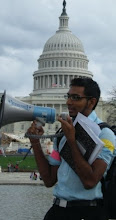
My name is Travis Ballie and I am a a criminal phonebanker. I'm an addict of politics. I'm a suffer of the Beltway.

I am also experiencing a phenomena known as being an undegraduate at American University. I have had this condition for 4 years, however I have been told that I will be getting a cure soon, known as "graduation".

All posts are my responsibility and I sincerely apologize for taking up precious minutes of your life. Of course, if you like anything I say I encourage you to massage my ego and comment!

I look forward to sharing with you my insights and quirks. Put your seatbelt on, because I don't want to get a ticket on this ride.